Grief and bereavement
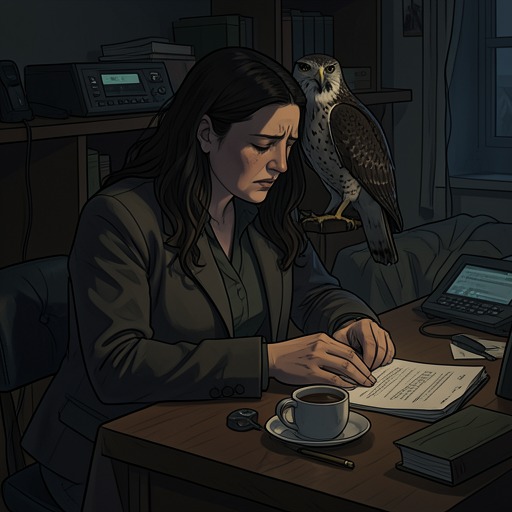
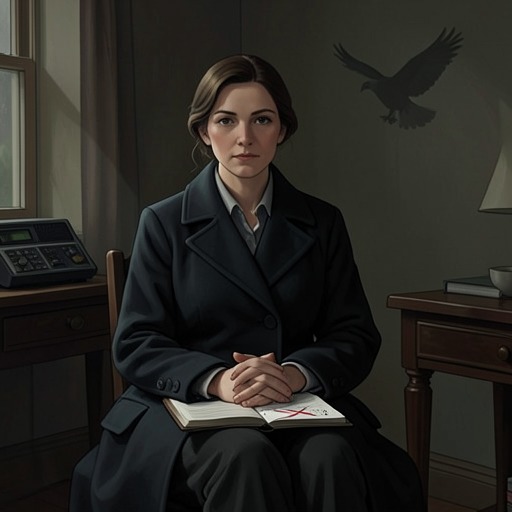
H is for HawkGrief and bereavement in the memoir are not a single emotional stage but a disorienting condition that alters how Helen Macdonald experiences time, memory, and the living world. Her father’s death breaks the continuity of ordinary life, while the effort to make sense of that loss repeatedly gives way to solitude, delayed distress, and an intense identification with a goshawk. The book’s fractured recollections make grief’s course part of its form: memories recur out of order because loss cannot be readily arranged into a stable story.
Loss as deprivation and isolation
Bereavement first arrives through a phone call. Helen is preparing to leave home when her mother tells her that she has heard from St Thomas' Hospital; after a pause, Helen understands that her father has died. The news immediately interrupts an ordinary plan: she had been going to dinner with Christina, who is already there. Helen insists they go, but she cannot eat. At the restaurant, a complimentary chocolate brownie and ice cream do not comfort her. Instead, the sprig of mint prompts a memory of her father in Hampshire a few days earlier. The small cut stem becomes a reminder that what had seemed temporary and repairable is now irretrievable. The transition from dinner back to that recent visit shows how grief can seize upon an incidental object and make it carry the force of loss.
The memoir describes bereavement as a deprivation that is shared by a family yet experienced in isolation. Helen tries to explain this paradox to friends by imagining people who suffer the same shock together but are each too overwhelmed to feel accompanied. Her explanation does not land as intended: the friends’ reactions make clear that she has not made the experience comprehensible to them. The scene distinguishes the fact of collective loss from the private character of grief. Family members may be bound by the same death, but that does not make any one person’s experience accessible to the others.
Disrupted memory and ordinary life
After the funeral, Helen returns to Cambridge. She does not sleep, drives repeatedly, and watches the sun at different times of day. Pigeons court on the lawn outside her house, while planes land, cars travel, and people continue their routines. These ongoing activities offer no explanation for her loss. Helen experiences herself as profoundly altered even as the external world persists without visible interruption, a contrast that makes everyday life seem difficult to interpret.
Her memories of the period do not settle into chronological order. She describes them as heavy blocks that can be placed in different arrangements without forming a coherent narrative. In one recollection, she and her mother walk from Waterloo toward the hospital beneath clouds. Her mother offers the hope that the experience will later seem like a bad dream. The family receives her father’s belongings and leaves with them in a plastic bag; at Waterloo Bridge, looking over the River Thames, Helen smiles for the first time since the phone call. The passage does not present that moment as a resolution. Instead, the ordinary movement of water briefly gives her something intelligible within a life whose prior structure has disappeared.
Attempts to make grief legible
Helen initially tries to understand her state through books on loss and bereavement. Their accounts of familiar responses and numbered stages seem to offer a framework, and she worries about identifying which stage she occupies. But the categories do not match what she recognizes in herself. The effort to classify grief therefore exposes a gap between general descriptions and lived experience: information can name common patterns without making this particular loss orderly or predictable.
A different kind of disorientation follows. Helen describes finding extraordinary significance in coincidences, believing her horoscope, experiencing déjà vu, and sometimes feeling that her father is nearby while she is on a train or in a café. Time no longer seems to proceed in a straightforward direction; memories and new events appear to cross one another. She recognizes these experiences as related to grief through what she has read, but naming them does not restore a stable sense of reality. The memoir presents this unsettled perception as an attempt by the mind to construct a habitable world after the former one has been lost.
Delayed distress and renewed attachment
As the weeks pass and early summer arrives in Cambridge, Helen begins to think that she is recovering. She later recognizes that confidence as premature. In June, amid an unacknowledged need for connection, she falls in love with a man who withdraws when he understands how distressed she is. His disappearance intensifies her state, and a red dress remains associated with that period in a way that makes it unwearable. The episode shows grief extending beyond the immediate family loss: the search for attachment becomes entangled with bereavement, and a new separation compounds rather than repairs the earlier one.
At the same time, persistent rain and reports of floods seem to make the wider world echo her inner experience. The River Cam rises through Cambridge, and Helen describes the city as transformed by the water. This correspondence is not offered as evidence that nature can cure grief. Rather, the surrounding weather becomes part of how she perceives a world already charged with loss. When she begins dreaming repeatedly of goshawks, the dreams mark a further change: her attention is turning toward a figure she can invest with qualities she cannot find in her own life.
The goshawk and the memoir’s account of grief
The goshawk that occupies these dreams is linked to an earlier encounter at a bird-of-prey centre near the Forest of Dean. An adult female had been brought there after striking a fence while hunting. The staff examined her, and Helen recalls the bird’s formidable presence and the moment she fixed her gaze on her. Years later, as grief unsettles her, this memory returns with particular force. The connection between loss and hawks is therefore not simply an abstract symbol introduced after her father’s death; it draws on a specific earlier encounter that has acquired new meaning in retrospect.
When Helen trains a young goshawk, she initially expects the experience to resemble the ordeal described by T. H. White in The Goshawk. Instead, the bird sleeps, and Helen wakes from a distressing dream disoriented and anxious about what is wrong with them. She comes to understand that the hawk is a baby and is behaving normally; the disturbance belongs to her own bereaved state. In that moment, the bird becomes a model for qualities she longs to possess: solitude, self-possession, freedom from grief, and numbness to human pain. Her recognition that she is turning into a hawk is not a literal transformation but an account of psychological identification. Grief has driven her toward an imagined escape from human vulnerability, setting in motion the memoir’s central exploration of what she seeks in the wild bird and what that attachment can—and cannot—resolve.